
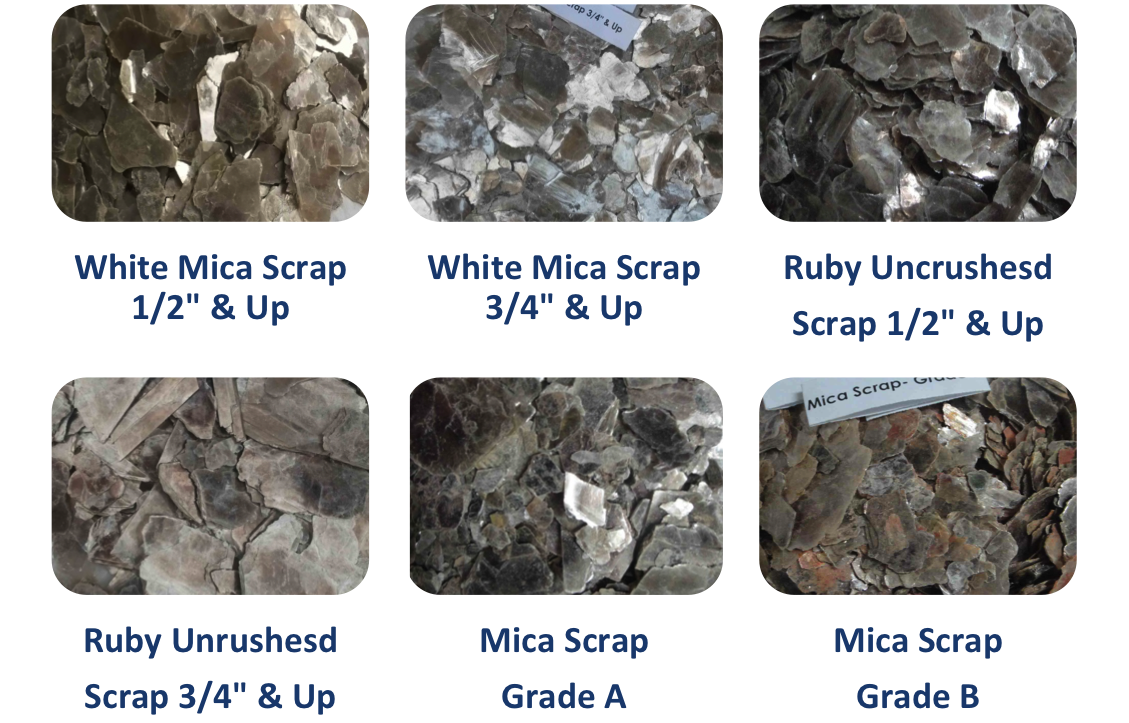
Mica scrap is the starting point for some of the most widely used mica insulation materials. Mica paper mills turn it into pulp and then into continuous mica paper; that paper becomes mica tape, reconstituted mica plates and laminates for motors, generators, heaters and cables. Scrap is also the raw material for mica flakes and mica powder.
Because scrap is a bulk, irregular raw material, two lots described with the same name can behave very differently in a paper mill. This guide explains the main types of scrap that Prime Natural Resources (PNR) exports from Jhumri Telaiya, India, and how to write an enquiry that gets you a comparable, accurate offer. For a short overview of scrap versus flakes and powder, see our mica scrap, flakes or powder selection guide.
What mica scrap is
Mica scrap is made up of irregular lumps and pieces of natural muscovite mica recovered from mining and from sorting block mica. Pieces large and thick enough are classed as mica blocks; thinner pieces become thins, films and splittings. Much of what remains is sold as scrap.
That does not mean scrap is waste. For a mica paper line, scrap is the core feedstock, and its cleanliness, colour and consistency have a direct effect on how the pulp behaves and what the finished paper looks like.
Ruby (tested) scrap vs white (untested) scrap
PNR's mica scrap range is divided into two main families.
- Ruby mica scrap, also called tested scrap, comes from ruby muscovite. It is usually chosen where the buyer wants a cleaner, more uniform input, for example for mica paper used in electrical insulation.
- White mica scrap, also called untested scrap, is a broader category. It is widely used where the final colour and visual uniformity matter less, or as feedstock for flakes and powder.
Which family suits your line depends on your own product and process. If your mill already runs a particular scrap, the most reliable way to compare a new supplier is to send that specification or a reference sample, rather than relying on the name alone.
Crushed vs uncrushed
Ruby scrap is offered both crushed and uncrushed:
- Crushed scrap has been broken down further at source. Some mills prefer it because it is easier to feed into their own processing.
- Uncrushed scrap keeps the pieces closer to their natural size. Buyers who want to control crushing and cleaning themselves, or who sort the material on arrival, often ask for it.
Tell the supplier which form your equipment is set up for. If you are not sure, describe your pulping or processing steps and ask for a recommendation.
Size classes and grades
PNR lists scrap in size classes such as 1/2" & up and 3/4" & up, for both ruby (crushed and uncrushed) and white scrap, and also offers scrap in Grade A, Grade B and Grade C.
A size class tells you the minimum piece size the lot is sorted to. It does not, on its own, say how much fine material, dust or foreign matter is acceptable. If those points matter to your mill, put them in writing in your enquiry, so every offer you receive is quoting the same thing.
What affects mica paper quality
From a buyer's point of view, the scrap-related points that most often cause disputes are:
1. Foreign matter — stones, quartz, feldspar, soil or other minerals mixed with the mica.
2. Colour consistency — mixing ruby and white material, or stained pieces, in one lot.
3. Moisture — scrap that is wet when packed or exposed during transit.
4. Fines — too much small material relative to the size class ordered.
5. Lot-to-lot variation — a first shipment that matches the sample, and later shipments that drift.
None of these needs a complex specification. A clear written description, a reference sample and an agreed inspection point solve most of them.
What to include in your RFQ
To get a quote you can compare across suppliers, send:
- Application — mica paper, reconstituted plates, flakes or powder production, or another use.
- Scrap type — ruby (tested) or white (untested); crushed or uncrushed.
- Size class or grade — for example 1/2" & up, 3/4" & up, or Grade A/B/C, plus any limits on fines.
- Cleanliness requirements — acceptable foreign matter, colour mixing and moisture, if you have them.
- Quantity — trial lot and expected monthly or annual tonnage.
- Packing — bag type and size, palletising or loose loading in containers.
- Destination — port or delivery point and preferred Incoterm.
- Documents — any certificate, inspection or test report you need with each shipment.
- Reference — your current specification or a sample from your existing supply.
PNR works with both trial lots and repeat tonnage, with no minimum order quantity. Samples can be arranged, with the buyer covering the material and freight cost.
Why source mica scrap from Jhumri Telaiya
Koderma and Jhumri Telaiya in Jharkhand are among India's traditional mica processing centres. Being located there lets PNR sort and grade scrap close to where it is collected, and prepare consistent lots for export along with our other raw mica products.
If you buy splittings for micanite or mica tape as well, you can combine your requirements in one enquiry: see our guide to mica splittings, bookform vs loose.
Request a mica scrap offer
Send your scrap type, size class, quantity and destination to mica@pnrmica.in, call +91 82941 54582, or use our contact page. If you share your current specification or a sample, we will match it as closely as possible and confirm what we can supply before you place an order.